TomCarpenter
Chez asap.work depuis
September 2023
From companions to historic monuments, Tom forges his path as a carpenter with humility and passion.
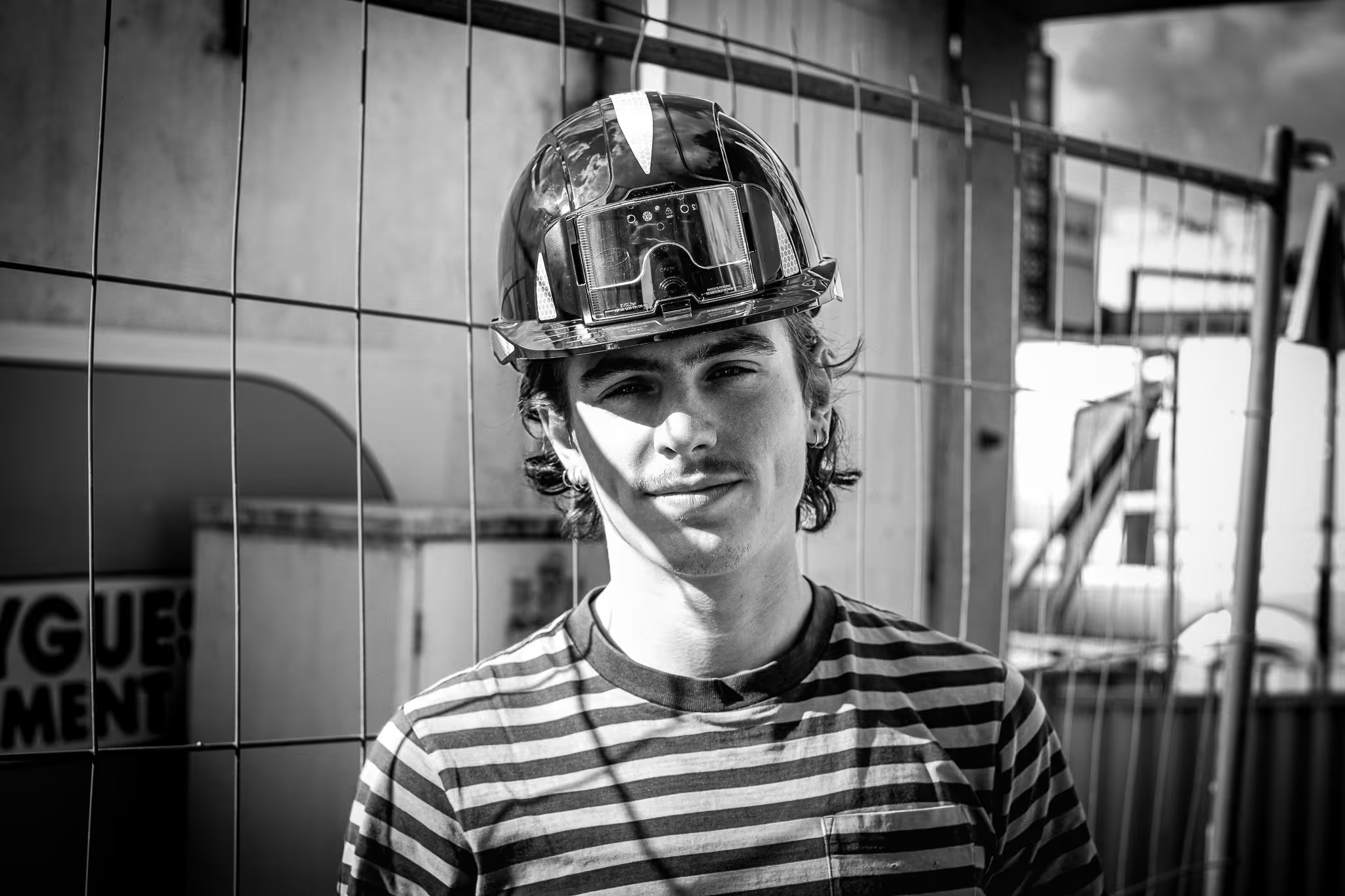
What I like is building something concrete with my hands.
Between his first steps with journeymen and iconic construction sites like Chantilly, Tom tells how carpentry became more than a profession: a revelation.
In just three years, Tom has already set foot on two of the most emblematic construction sites in France: the Chateau de Chantilly and Notre Dame de Paris. Starting from a high school diploma without a specific idea of profession, he discovered carpentry almost by chance and quickly realized that he had found his way. Trained by alumni, immersed in a demanding, raw and passionate universe, Tom learns quickly. Between pressure, precision and transmission, he moves forward with humility and curiosity, proud to contribute to projects that will make history.
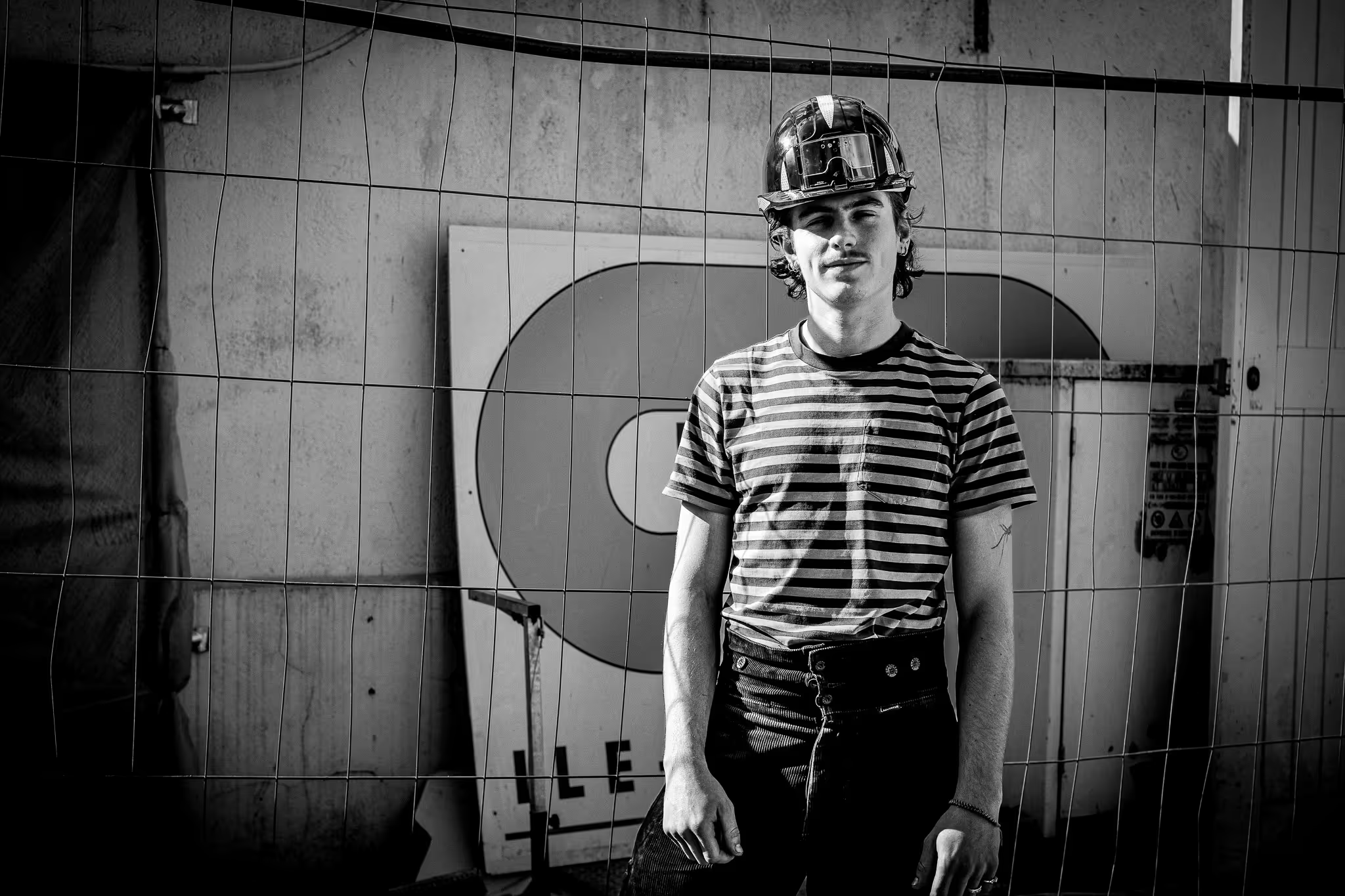
The ancients taught me everything. If you listen and stick with it, it goes away.

His look at theFuture of the profession and the place of young people in the sector

Sa pride to work on projects that shape the daily lives of Ile-de-France residents

Les technical challenges which he was confronted with.
In this interview, Tom Looks back on:
- Ses Beginnings in Carpentry, after a general baccalaureate and without a specific idea of profession
- His first years of apprenticeship with Ancients, between transmission and field requirements
- His experiences on Exceptional Projects like Notre Dame de Paris and the Chateau de Chantilly
- Les Business challenges, between weather, height, precision and time pressure
- His vision of Construction like a real world, where you learn by doing and by listening
Beyond his career, Tom shares a sincere and humble word about the reality on the ground:
“Frankly, just try. Open yourself up to that world, it's true.”
Through this testimony, asap.work Continue to Highlight The Artisans Who Build and to encourage new generations to discover jobs that are as demanding as they are fascinating.
Hi Tom, Thanks for taking the time today to tell your story. You've been a carpenter for not very long, it's been three years, and yet you have already worked on two major projects: Chateau de Chantilly and Notre Dame. I think you have a lot to talk about. The first thing I want to know is where are you from, who are you?
I was born in Paris, I come from the 10th arrondissement around République I was born there, I grew up there and I had a classical school career. I stayed in the general baccalaureate and after the general baccalaureate, I did not really know what I wanted to do so I thought a little bit. I knew that I wanted a fairly manual job where you left the office and didn't have anything fixed.
I Headed Over to the Frame to Try. In fact I was thinking more about disadvantages that I didn't want to have rather than something that I necessarily wanted to do. By thinking about the materials I wanted to work with, I found myself on this and in the end I like it.
It's crazy because construction is not a sector where you naturally choose. Do you have any guys in your family who are in the construction industry?
I have my grandfather who was a house. He had his masonry business. He came from Algeria and he came to France with his father. His father had his masonry business in Algeria and as a result, he recreated a business in France. He developed the business but he has two daughters, who did not take over so he sold it. I didn't dive into it because I didn't see him work that hard and he didn't lead me in there, but I think that deep down there was a relationship anyway.
Do you remember a little bit about your first project?
My first project was when I was alternating with the journeymen, I was with the carpenters of Paris and I did a construction site, it was in 77, a pavilion, I know more exactly the city and it was it was quite cool after it was a site that I could not appreciate too much technically because I did not yet have the skills.
Did you you did you have people who accompanied you, who explained the job to you or did you do it yourself a bit?
So, I was with what people call “old people” in the world, well in the sense of people who were between 50 and 60 years old who accompanied me a bit throughout the year, I worked with different people, but these people taught me a lot.
What Does Your Day Look Like a Little Bit Like?
My day usually starts between 7 and 8 am, working in the morning, eating and finishing in the afternoon.
Do you have seasonality in your job or not?
It depends, in Île-de-France, we are not too affected by this because we do not have such a violent change in temperature compared to the mountains or other regions, but as a result there is a greater impact on yourself, the way you work and on the intensity of work.
Do you have a mission that particularly touched you, where did you say to yourself I am proud, or will it be complicated?
One of the projects that impacted me the most was Notre Dame because the place is crazy anyway. There is immediately a pressure that you put on yourself, especially I arrived late so a lot of pressure and a lot of waiting. They were just people who were passionate about their job who worked there so at the same time they were very kind and tried to transmit and at the same time there was still pressure, you must not mess around, you must not mess around, you must not miss a piece because you can't afford to.
And what is the hardest part of your job?
For me, the hardest part is still the weather, for example in winter when it's really very cold, for example, when it's really cold, a nail that sticks to your finger in real life it marks a bit, it's a bit boring and then even summer when it's very, very hot, it can be complicated.
What advice would you give to a guy starting out as a carpenter?
The first thing is that you have to know how to swallow your ego a bit because in fact you arrive in an environment that is quite raw, a bit violent, people can be very candid and dry. So it can be a bit hard, but in fact for me if you manage to have a goal and if things are a little bit placed and you come across the right people, it will be fine, you just have to know how to accept comments a bit.
And you talk a little bit about your job to those around you, to your parents, to your loved ones? How do they perceive the job tone?
My parents are proud of what I do. I am lucky to have parents who have always encouraged me to try to do something that I enjoy. My friends, my friends, and so on are people who are still studying, so we have completely different backgrounds and days and that's why they're intrigued and in real life it's pretty funny.
Do you still see yourself in the construction industry in 10 years?
Yeah yeah, definitely huh. I know that I have other passions and things that could take over but that's to be seen and for now I know that I don't have anything that tells me that I don't want to continue.
Do you often say thank you, do you feel recognized in your job or not at all?
I know that within the company that is going to hire me this is quite rare because these are environments where they don't set up that much. After that, I have a special relationship with Benjamin my consultant, we understand each other very well and we know how to say thank you when we need to or when we help each other out. And besides that, I know that people outside of construction sites, for example my friends, tend to value the thing enormously, as if I were a doctor, when in real life I don't find it comparable personally.
And the castle of Chantilly?
Chateau de Chantilly, very cool, a pretty important experience because I stayed quite a long time and on top of that it was techniques that I didn't know at all, really specific to historical monuments. The team leader was quite young and we understood each other quite well. It was quite tough but as soon as I listened and he saw that it was in fact spinning, it was very rewarding.
And do you feel that your job will evolve over the years?
I already know about the machines that can be used in the workshop because so we still have a part that we will cut on site but there are a lot of workshops. In fact, workshops are taking up more and more space in the framework because we have machines like the K2 that automates just about everything. You can make cuts on 3D plans and so that summarizes the work of the frame to do more installation, so installing what has already been cut in the workshop more than doing it on site, what.
And do you have a model on site at the moment?
There is another temporary worker with whom I worked a lot called Tristan, who is also at ASAP and who works with Benjamin. I put him last year and we don't have the same construction experience at all. We are in different areas and we have quite different ways of working but we work very well together.
So I suppose this is a colleague you will never forget?
Oh no, I travelled with him for two months last year and it's an experience that connects us.
So your job is sometimes very far from your home, do you travel a lot?
So maybe less so. As I know that you have developed travel quite recently, I have not had much opportunity to do it. But so when we moved last year where I think it was one of your first me I would like it well after that it depends with whom and how.
Carpentry is a great job, is it something that scares you?
I was born dizzy but when I arrived in carpentry during high school, I climbed a lot on roofs with friends so in fact it got me used to the height a lot and on top of that it's really the same frame as the frame in fact in fact so suddenly it helped me a lot and then after that with the years it also improves.
You still have a lot of security around your job anyway, don't you?
This is something that has evolved a lot, I know that when I talk to people of 50/60 years old the means were absolutely not the same. Helmets, for example, hardly existed, whereas currently we are forced to wear them all the time. There are a lot of things that are put in place, even for example nets when you work and that you cannot be retrieved otherwise, nacelles, harnesses, there are lots of things that make it all secure.
Do you want to leave a note, an advice for a young person who is starting out in this profession?
Frankly just give it a try. Try it and just open yourself up to this world a bit too because I think it's a reality that people don't necessarily have sometimes, but I think that the building environment is still quite real so it can be a very good experience.