Retour aux articles

Conseils BTP et intérim

Becoming an Excavator M/F: job, salary and missions

In 2025, the earthworker's station is central to preparing the ground before any construction.

Introduction

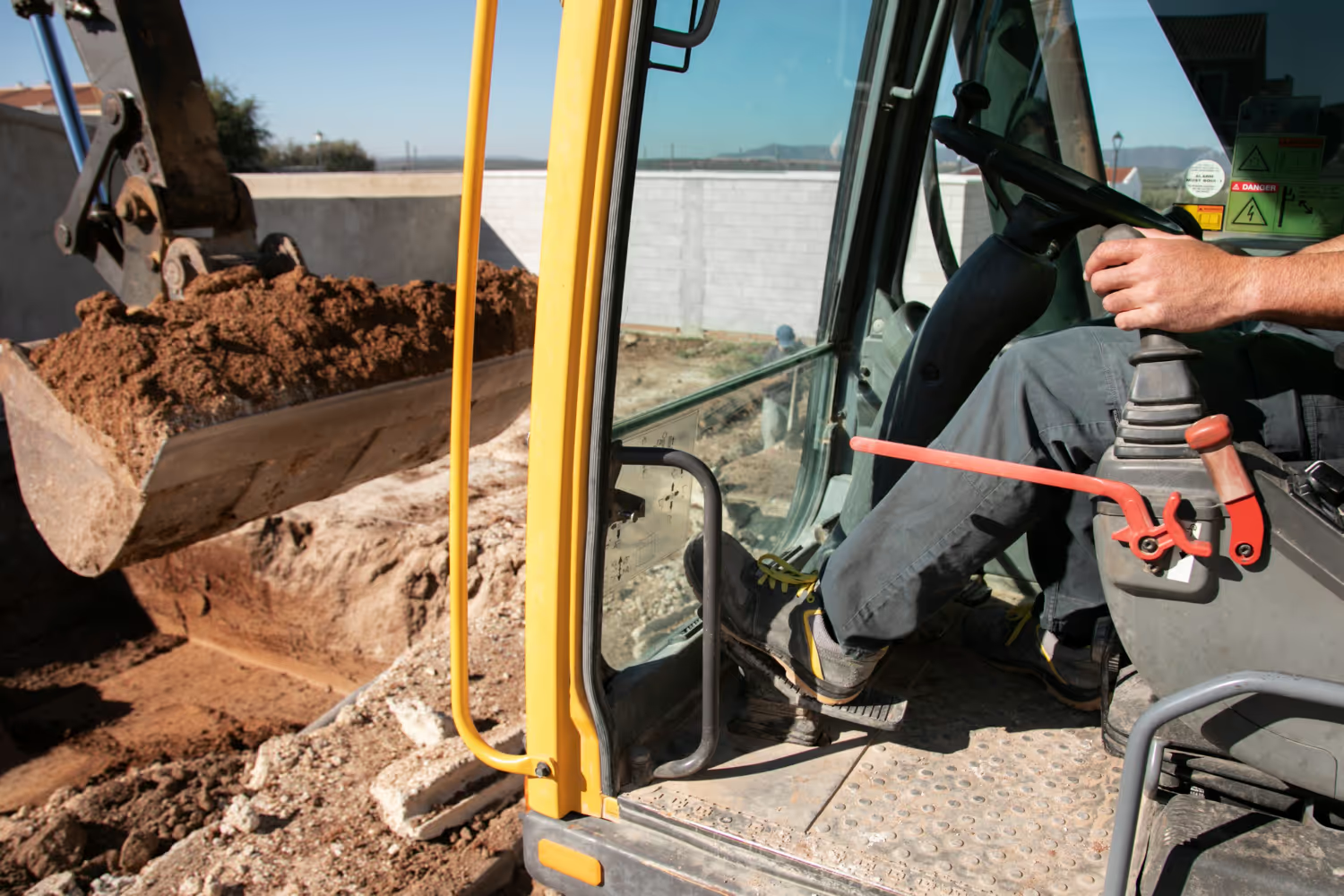
In 2025, the earthworker's station remains essential to prepare the soil before any construction. With his machines or his shovel, he shapes the ground, digs foundations and trenches, and ensures the stability of the structures. A physical and indispensable profession, it forms the basis of the work site.

But before handling the gear or the pickaxe, you must go through a CAP, a Bac Pro or obtain the appropriate CACES. This sheet details the missions, training, salaries and opportunities to become a digger.

Why train as a digger?

A key job in the preparation of construction sites


The digger prepares the ground before any construction. He digs foundations, builds trenches and shapes soils to accommodate roads, buildings or networks. A physical and indispensable profession, it forms the basis of any construction site.

The sector's figures confirm its importance:


✔ High demand in public works and construction.

✔ Job accessible from CAP, with a lot of open apprenticeship positions.

A manual and formative profession


Use of machines, compliance with safety standards, adaptation to the terrain: the digger must be enduring and versatile. It is a job where field experience is essential.

Training to become a digger: everyone has their own career path

What training courses should you follow to become a digger?

The different types of training available

  1. CAP Public Works Equipment Operator
  • Duration: 2 years after the 3rd.
  • Audience: young people or adults in the process of retraining.
  • Objective: Learn to use shovels, bulldozers, graders to make earthworks, trenches and embankments.
  • Where? CFA TP, vocational high schools, AFPA.
  1. CAP Road Builder
  • Duration: 2 years.
  • Audience: post-3th.
  • Advantage: preparation and implementation of earthworks, pavements and ancillary structures.
  • Where? CFA TP, vocational high schools.
  1. Bac Pro Public Works
  • Duration: 3 years
  • Audience: post-3th or holders of a CAP.
  • Advantage: team management, site management, topography and safety.
  • Where? technical high schools, CFA, TP schools.
  1. Professional Equipment Operator/VRD Worker titles
  • Duration: 6 to 12 months
  • Audience: adults in retraining, temporary workers.
  • Advantage: rapid specialization in earthworks, VRD networks, installation of borders and manholes.
  • Where? AFPA, GRETA, private TP centers.
  1. Certificates and CACES R482 (Construction equipment)
  • Duration: 3 to 5 days per category.
  • Audience: employed professionals, job seekers.
  • Advantage: mandatory to drive the machines (shovel, loader, bulldozer, compactor...).
  • Where? certified organizations, OPCO, companies.
  1. Alternation
  • Advantage: direct implementation (earthworks, trenches, embankments) + remuneration.
  • Compatible courses: CAP, Bac Pro, Pro titles.
  • Where? construction companies, VRD, construction companies.
  1. VAE/Continuing education
  • Audience: experienced diggers.
  • Objective: validate a CAP/Bac Pro through experience, or obtain/renew your CACES.
  • Ideal for: aim at earthmoving team leader or confirmed multi-machine driver.

Comparison of training courses — Terrassier

Formation Durée Public cible Avantages Prix
CAP Conducteur d’Engins TP2 ansJeunes, reconversionBases engins & terrassementsGratuit / CPF
CAP Constructeur de Routes2 ansJeunes, prosTerrassements & routesGratuit / CPF
Bac Pro TP3 ansPost-3ᵉ, CAPEncadrement, topographieGratuit / CPF
Titres Pro TP6–12 moisAdultes, prosInsertion rapide VRD/terrassementsCPF / OPCO
Certificats CACES R4823–5 joursSalariés, demandeurs emploiObligatoires conduite enginsEntreprise / OPCO
AlternanceVariableJeunes & prosExpérience + salaireEntreprise / OPCO
VAE / ContinueFlexiblePros expérimentésReconnaissance diplômes & CACESCPF / OPCO

💡 Coup d’œil Asap.work

Pour être vite opérationnel, combine un CAP Conducteur d’Engins avec les CACES R482.

Déjà expérimenté ? Une VAE Bac Pro TP + certificats sécurité travail en tranchée te propulsent vers chef d’équipe terrassement.

How does an earthworker training course take place?

Skills taught in training

By following a Terracer training (VRD/TP), you will acquire:

🏗️ Earthmoving techniques & VRD

  • Implementation, drawing and reading of plans (dimensions, slopes, altimetry).
  • Excavation in full mass, in trenches, excavations and embankments.
  • VRD networks: preparation of foundations, adjustment, compaction, installation of edges/drains.
  • Material management (stripping, backfill, topcoat) and load carrying capacity controls.

⚠️ Safety, regulations & environment

  • Construction site signs, markings and vehicle/pedestrian exclusion zones.
  • Safe driving near networks: AIPR (operator).
  • Risk prevention (trenches, landslides, traffic), OSH.
  • Management of runoff water, dust, sorting and disposal of excavated material.

🛠️ Professional situation

  • Workshops and technical platforms: laser adjustment, vibrating plate, compactor.
  • Levelling exercises (ruler, rotating laser) and slope checks.
  • School sites and alternation in TP/VRD companies.
  • Introduction to 2D/3D guidance, production monitoring and traceability.

Access conditions

  • CAP Road Builder/Pipeline Builder : accessible after 3rd.
  • Bac Pro Public Works : to expand to VRD/construction techniques and team organization.
  • Pro Ouvrier VRD/Terrassier titles : rapid retraining (6 to 12 months).
  • VAE : possible from 1 year of experience on earthmoving worksites/VRD.

The steps to integrate a training

  • Parcoursup : for CAP/Bac Pro in professional high schools and CFA TP.
  • Direct application : AFPA, GRETA, TP centers (Pro titles, VRD modules).
  • Adult retraining : mobilize CPF, OPCO, France Travail; POEC devices possible.
  • Alternation : TP/VRD companies, majors and local SMEs.

Comparison of training courses — Terrassier

Nouveau call-to-action

Opportunities and possible evolutions for a digger

From earthmoving worker to field supervisor

Confirmed digger: You drive the machines, carry out excavations, levelling and embankments with precision.

Earthmoving team leader: You organize the work areas and supervise several companions.

Supervision and management

VRD/earthworks site manager: responsible for heavy earthworks, networks and roads.

TP work manager: You supervise the major earthworks and road infrastructures.

Specializations

Urban earthworks: interventions in restricted areas (city centers, existing networks).

Long linear earthworks: highways, railways, major projects.

Footbridges

Confirmed machine operator: if you complete with all the gear boxes.

Site logistics manager: organization and optimization of material flows.

Conclusion

Becoming a digger means preparing the ground, shaping the ground and laying the foundations of any construction. A physical but essential profession, it offers real prospects. Do you want to move forward? Asap.work can help you find your next mission. 🚜🏗️

Take action and shape the foundations of tomorrow.

What is the salary of a digger?

The salary of a digger starts around €1,850 gross/month, and can rise to €2,700 gross/month with experience or versatility on machines.

Can you become a digger without a BTS or higher diploma?

Yes, it is possible to become a digger without a degree. The job is accessible through field experience, but machine cages are a major asset.

Is the job of earthworker very physical?

Yes, it is a physically demanding job, even if the use of construction equipment relieves some of the effort. Physical fitness is essential.

What are the working conditions of a digger?

He works outside, in all weathers, often on heavy construction sites. Physical profession with frequent use of machines.

Nos ressources

Nos dernières ressources

Calcul du salaire pour 24h par semaine : guide pour les recruteurs du BTP

Bien comprendre le calcul du salaire pour 24h/semaine est indispensable pour proposer une rémunération juste et conforme à la loi.

Contrats et réglementations

SMIC Net 2026 : Tout savoir sur ton salaire et son évolution (Guide complet)

Tu viens de recevoir ta première paie de l’année ou tu cherches ta prochaine mission d’intérim et une question te brûle les lèvres : combien gagne-t-on vraiment en 2026 ?

Entreprise

Créer une offre d'emploi irrésistible : Le guide complet pour attirer les meilleurs talents BTP en 2026

Dans un marché du travail sous tension, où la pénurie de main-d'œuvre qualifiée dicte sa loi, votre capacité à recruter ne dépend plus seulement de la notoriété de votre enseigne. Elle dépend de votre vitrine immédiate : votre annonce.