Retour aux articles

Conseils BTP et intérim

Becoming an IRVE Technician M/F: job, salary and missions

In 2025, the IRVE technician position is essential to install and maintain electric charging stations.

Introduction

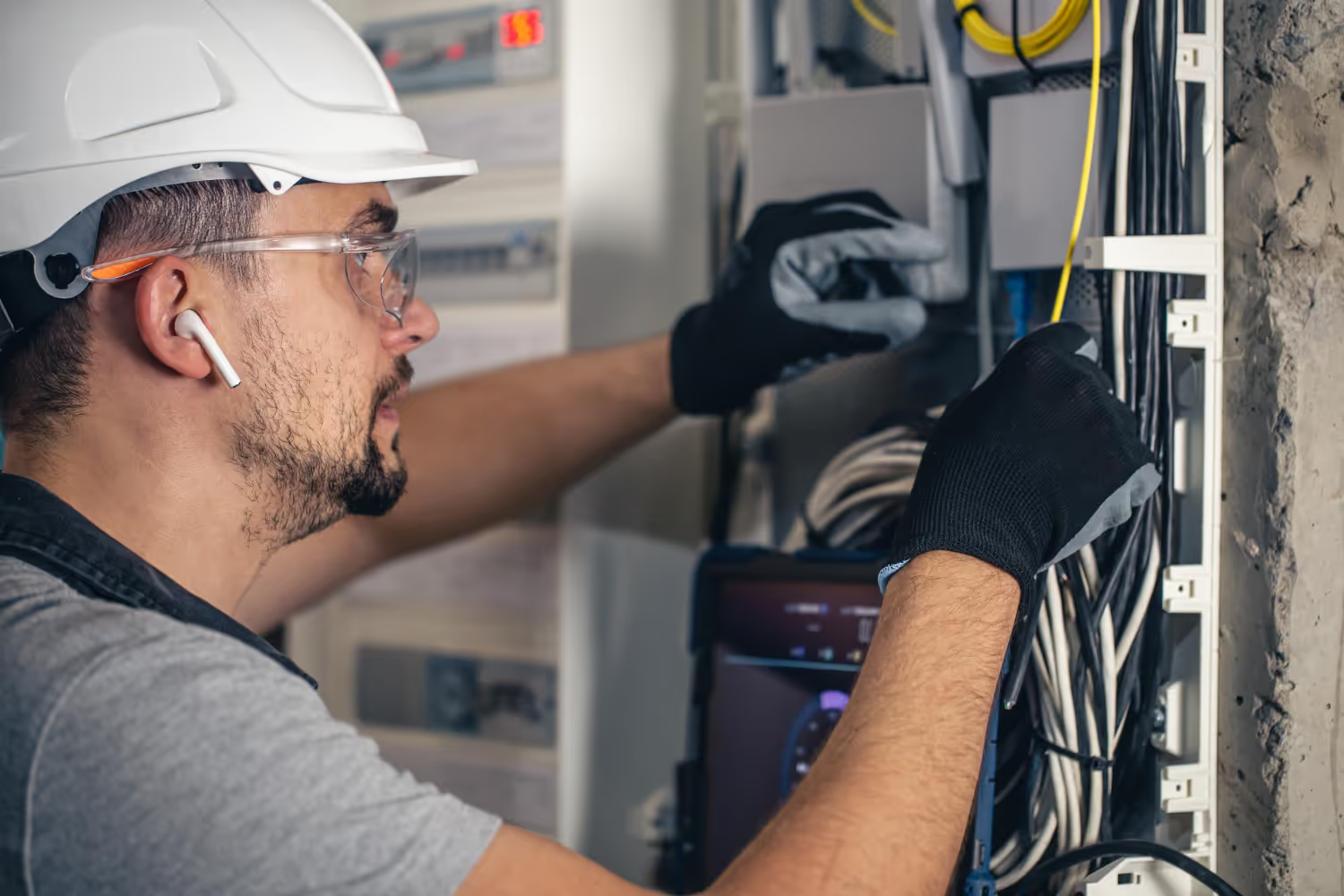
In 2025, the position of IRVE technician (Electric Vehicle Charging Infrastructures) is essential in the development of electric mobility. It installs, connects and maintains charging stations, guaranteeing safety and performance.

But before intervening on these installations, it is necessary to obtain electrical authorization and follow appropriate training: Bac Pro, BTS or IRVE specialized title. This sheet details the missions, training, salaries and prospects for becoming an IRVE technician.

Why train as an IRVE technician?

A key profession in electric mobility


The IRVE technician installs and maintains charging stations for electric vehicles. A technical and booming profession, it plays a central role in the transition to sustainable mobility.

The sector's figures confirm its importance:


✔ Rapid growth of the IRVE market with the objective of several hundreds of thousands of charging stations by 2030.

✔ Job in tension, with a sustained demand for qualified profiles.

An electrical and innovative profession


Wiring, connection, configuration: the IRVE technician must be skilled in electricity and attentive to safety standards. A modern profession, it combines technical know-how and innovation.

Courses to become an IRVE technician: everyone has their own career path

What training courses should you follow to become an IRVE technician?

The different types of training available

  1. CAP Electrician
  • Duration: 2 years after the 3rd.
  • Audience: young people or adults in the process of retraining.
  • Objective: basics in electricity, wiring, connection of small equipment.
  • Where? CFA, vocational high schools, AFPA.
  1. Bac Pro Jobs in Electricity and its Connected Environments (MELEC)
  • Duration: 3 years
  • Audience: post-3th or holders of a CAP.
  • Advantage: preparation for the installation and maintenance of electrical equipment and charging stations.
  • Where? technical high schools, CFA.
  1. BTS Electrical Engineering or BTS Fluids, Energies, Home Automation
  • Duration: 2 years after the Bac.
  • Audience: students or professionals in retraining.
  • Advantage: sizing and configuration of IRVE installations, management of technical sites.
  • Where? technical high schools, IUT, CFA.
  1. Title Pro Installer in Charging Infrastructures for Electric Vehicles
  • Duration: 6 to 12 months
  • Audience: adults in retraining, temporary workers, job seekers.
  • Advantage: short and targeted training, allowing rapid intervention in the field.
  • Where? AFPA, IRVE specialized organizations, manufacturers.
  1. IRVE certifications (P1, P2, P3)
  • Contents: IRVE standards, electrical safety, communication with vehicles and networks.
  • Advantage: essential to be recognized by operators and manufacturers.
  • Where? approved organizations (QUALIFELEC, AFNOR, etc.).
  1. Alternation
  • Advantage: immediate practical experience + remuneration.
  • Compatible courses: CAP, Bac Pro, BTS, Pro Title.
  • Where? electrical companies, IRVE operators, certified installers.
  1. VAE/Continuing education
  • Audience: experienced electricians or technicians.
  • Objective: validate an IRVE diploma or certification through experience.
  • Ideal for: evolve to IRVE team leader or electric mobility business manager.

Comparison of training courses — IRVE Technician

Formation Durée Public cible Avantages Prix
CAP Électricien2 ansJeunes, reconversionBases élecGratuit / CPF
Bac Pro MELEC3 ansPost-3ᵉ, CAPÉlec + IRVEGratuit / CPF
BTS Électrotech / FED2 ansPost-bacDimensionnement + maintenanceGratuit / CPF
Titre Pro Installateur IRVE6–12 moisAdultes, prosInsertion rapideCPF / OPCO
Certifications IRVE3–10 joursPros actifsReconnaissance nationaleEntreprise / OPCO
AlternanceVariableJeunes & prosExpérience + salaireEntreprise / OPCO
VAE / ContinueFlexibleExpérimentésDiplôme / certif IRVECPF / OPCO

💡 Coup d’œil Asap.work

Pour entrer vite dans le métier, passe un Titre Pro IRVE et les Certifications P1 à P3.

Déjà électricien ? Une VAE Bac Pro MELEC + certif IRVE te propulse vers chef d’équipe ou chargé d’affaires mobilité électrique.

How does an IRVE technician training take place?

Skills taught in training

By following an IRVE Technician training, you will acquire:

⚡ Installation of charging stations

  • Reading electrical diagrams and layout plans.
  • Installation, connection and commissioning of IRVE terminals (domestic, tertiary, rapid).
  • Parameterization and software configuration of connected terminals.
  • Functional tests and conformity certification.

🔧 Electrical and normative skills

  • Control of standards NFC 15-100 and CUTE C15-722.
  • Sizing of electrical protections (circuit breakers, differentials, surge protectors).
  • Mandatory electrical certifications (B2V, BR, BC).
  • Knowledge of communication protocols (OCPP, RFID, supervision).

🌍 Energy and sustainable mobility

  • IRVE integration with solar self-consumption and battery storage.
  • Intelligent load management (smart charging, load balancing).
  • Environmental impact and regulations related to electric mobility.

🛠️ Professional situation

  • School sites: installation and configuration of real terminals.
  • Alternating with IRVE installers, electricity companies or energy operators.
  • Use of measurement tools: insulation controllers, power meters, vehicle simulators.

Access conditions

  • CAP Electrician or MELEC Pro Bac : necessary electrical basics.
  • BTS Electrical Engineering or CIEL : opens to the installation of complex terminals.
  • Additional mention IRVE : rapid specialization after Bac Pro/BTS.
  • IRVE Installer Pro Title : short training (6 to 12 months) for retraining.
  • VAE : possible from 1 year of experience in electrical installation.

The steps to integrate a training

  • Parcoursup : for CAP/Bac Pro/BTS in electrical engineering.
  • Direct application : AFPA, GRETA, certified organizations Qualifelec IRVE.
  • Adult retraining : via CPF, OPCO, France Travail.
  • Alternation : electrical companies, IRVE installers, mobility operators.

Nouveau call-to-action

Opportunities and possible evolutions for an IRVE technician

From installer to IRVE specialist

Confirmed IRVE technician: You install and configure charging stations for all types of vehicles.

IRVE team leader: You coordinate interventions and manage the electrical safety of construction sites.

Supervision and development

IRVE works manager: You manage several projects, budgets and deadlines related to charging stations.

Electric mobility business manager: you develop IRVE projects with local authorities and private companies.

Specializations

Fast/high power terminals: highly sought-after technical specialization.

Smart charging: integration into the smart grid and energy optimization.

Footbridges

Electrical network technician: expansion to distribution infrastructures.

IRVE trainer: transmission of authorizations and best practices.

Conclusion

Becoming an IRVE technician means installing and maintaining charging stations for electric vehicles. A key business in the energy transition, in full growth. Do you want to make progress? Asap.work can help you. 🔌🚗

Take action and recharge the future today.

What is the salary of an IRVE technician?

The salary of an IRVE technician starts at €2,000 gross/month, and can increase up to €3,200 gross/month, especially on fast or high-power terminals.

Can you become an IRVE technician without a BTS or higher diploma?

No, impossible without a diploma: this position requires electrical training and mandatory IRVE certification.

What are the advantages of an IRVE technician on the job market?

IRVE technicians have a rare and highly sought-after specialization, in direct connection with the rise in power of electric vehicles and charging stations.

What are the working conditions of an IRVE technician?

He works mainly outside or in covered car parks, on the installation of terminals. Frequent trips, variable hours.

Nos ressources

Nos dernières ressources

Calcul du salaire pour 24h par semaine : guide pour les recruteurs du BTP

Bien comprendre le calcul du salaire pour 24h/semaine est indispensable pour proposer une rémunération juste et conforme à la loi.

Contrats et réglementations

SMIC Net 2026 : Tout savoir sur ton salaire et son évolution (Guide complet)

Tu viens de recevoir ta première paie de l’année ou tu cherches ta prochaine mission d’intérim et une question te brûle les lèvres : combien gagne-t-on vraiment en 2026 ?

Entreprise

Créer une offre d'emploi irrésistible : Le guide complet pour attirer les meilleurs talents BTP en 2026

Dans un marché du travail sous tension, où la pénurie de main-d'œuvre qualifiée dicte sa loi, votre capacité à recruter ne dépend plus seulement de la notoriété de votre enseigne. Elle dépend de votre vitrine immédiate : votre annonce.