Introduction
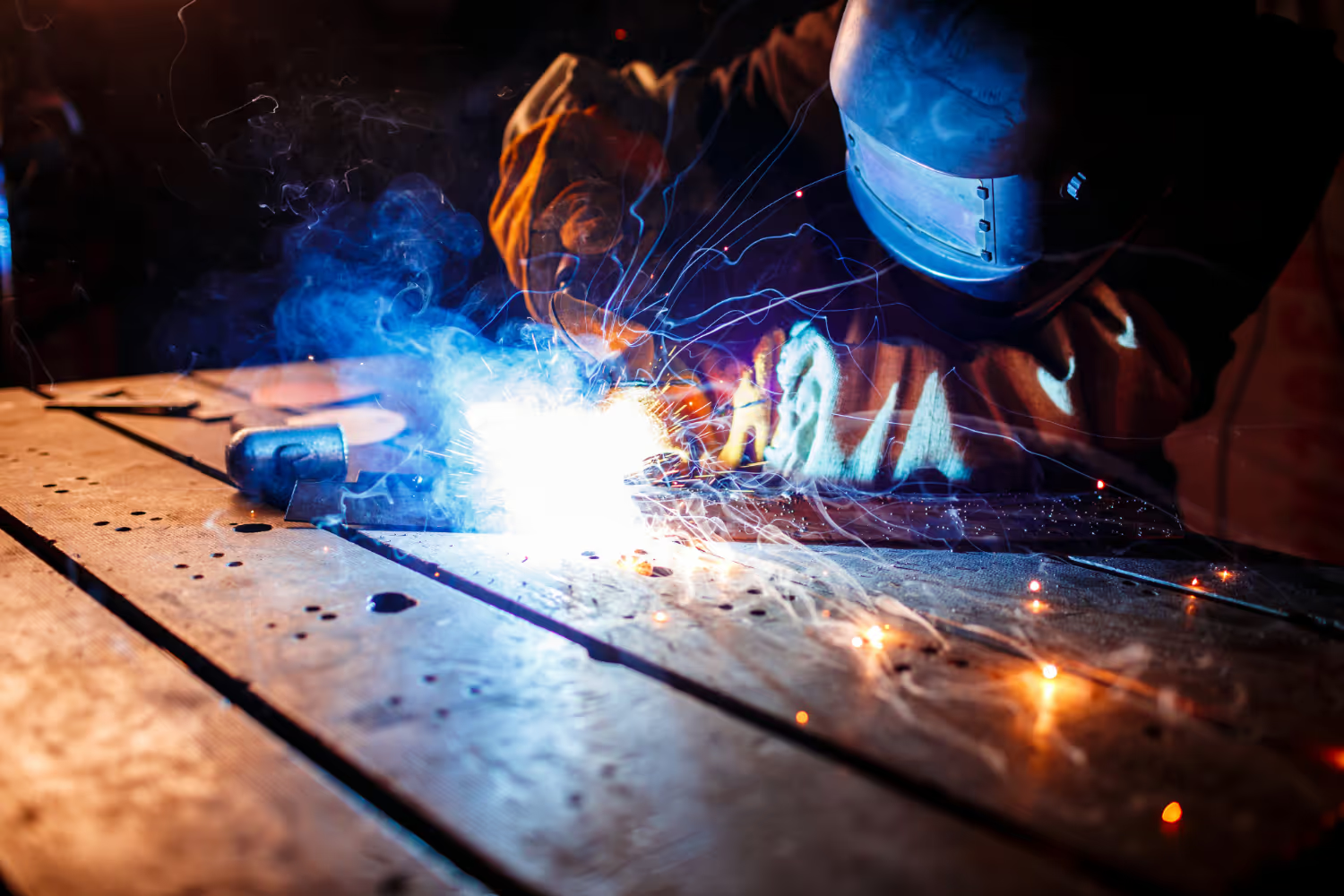
In 2025, the position of welder is still in high demand in construction and industry. A specialist in metal assembly, he works on various structures, from buildings to public structures. A technical and demanding profession, it requires rigor and mastery.
But before handling the arc or the torch, you must go through a CAP, a Bac Pro or a welding certification. This sheet details the missions, training, salaries and opportunities to become a welder.
Why train as a welder?
A key job in metal assembly
The welder assembles, repairs and secures metal structures using various welding techniques. Present in construction, industry and metal construction, it plays a crucial role in the solidity and safety of structures.
The sector's figures confirm its importance:
✔ Job in tension, with strong demand in France and internationally.
✔ Sustained recruitment in industry, energy and construction.
A technical and demanding job
Reading plans, mastering MIG, TIG or arc processes, compliance with safety standards: the welder must be rigorous and precise. It is a position that values technical mastery and attention to detail.
Training courses to become a welder: everyone has their own path
How does a welding training course take place?
Skills taught in training
By following a training course as a Welder, you will acquire:
🔥 Welding processes
- Welding MMA (coated electrode), MIG/MAG (steel/stainless steel/aluminum) and TIG (steel/stainless steel/aluminum).
- Setting the stations, choosing the gases, parameters and consumables.
- Positions and assemblies: flat, ledge, riser, ceiling; chamfers, end to end, angle.
- Reloading, pointing, clamping and sequences to limit deformations.
🧰 Preparation, reading plans & metallurgy
- Reading plans, isometric and DMOS/WPS (descriptions of operating procedures).
- Dimensioning, plotting, cutting (saw, grinding, plasma), deburring and adjustment.
- Metallurgy concepts: steel/stainless steel/aluminum grades, thermally affected zones, treatments.
- Jig assembly, dimensional control and preparation for welding.
✅ Quality control & traceability
- Visual checks (VT), penetrant testing (PT), magnetic particle inspection (MT) — awareness of CND.
- Reading of QMOS/WPQ, compliance with acceptance criteria (ISO 5817...).
- Traceability of welds, marking of parts and quality records.
- Writing reports and preparing for exams of welding licenses.
🛡️ Safety, health & environment
- Risk prevention: smoke, UV/IR, burns, fire, ATEX depending on context.
- PPE (gloves, auto-darkening hood, fireproof clothing), smoke extraction.
- Additional qualifications: work at height, overhead crane, SST.
- Gestures and postures, ergonomics, 5S and workshop cleanliness.
🛠️ Professional situation
- Workshops: test coupons, test tubes in different positions and processes.
- Construction sites and alternation in boilermaking, piping, locksmith-metalwork.
- Preparation and passage of welding licenses (QS welder).
- Basic CAD/CAD initiation for digital and isometric reading.
Access conditions
- CAP Realization in Industrial Boilermaking (RCI) or CAP Métallier : accessible after 3rd.
- Bac Pro TCI (Industrial Boilermaking Technician): to broaden to preparation/control.
- Pro/CQPM Welder titles : 6 to 12 months, adapted to adult retraining.
- VAE : possible from 1 year of experience to validate CAP/Bac Pro or CQPM.
The steps to integrate a training
- Parcoursup : for CAP/Bac Pro in professional and CFA high schools.
- Direct application : AFPA, GRETA, private centers (Pro titles, CQPM Welder).
- Adult retraining : mobilize CPF, OPCO, France Travail.
- Alternation : boilermaking companies, metallurgy, piping, industrial maintenance.
Comparison of training courses — Welder
💡 Coup d’œil Asap.work
Pour être très vite employable, vise un Titre Pro/CQPM Soudeur en alternance et prépare tes licences (QS) en MIG/MAG et TIG.
Déjà en atelier ? Une VAE + renouvellement régulier des licences et modules CND te propulsent vers des postes mieux rémunérés (tuyauteur, chaudronnier soudeur).
Opportunities and possible evolutions for a welder
From beginner welder to assembly expert
✅ Confirmed welder: You master several processes (MIG, TIG, ARC, plasma) and work on various sites.
✅ Welding team leader: You supervise several welders, ensure quality controls and safety.
Supervision and production management
Workshop manager: You manage metal manufacturing, organize the stations and follow the production.
Metallic work operator: You manage carpentry, pipe or boiler work sites.
Specializations
High pressure welding: nuclear, petrochemical, sectors with high responsibility.
Underwater welding: offshore interventions or port maintenance.
Footbridges
CND controller: You ensure checks by X-rays, ultrasound, magnetoscopy.
Welding trainer: you transfer your know-how to a specialized center.
Conclusion
Becoming a welder means assembling the metal structures that hold our structures together. A technical, demanding and highly sought-after profession, it opens up opportunities in construction and industry. Do you want to make progress? Asap.work can help you. 🔩🔥
✨ Take action and start building your future today.
What is the salary for a welder?
The salary of a welder starts at around €2,000 gross/month, and can rise to €3,000 gross/month depending on the specialization (TIG, MIG, ARC, ARC, high pressure welding).
Can you become a welder without a BTS or higher diploma?
No, without certifying training, it is impossible to practice. Welding certifications and procedures must be validated by specific diplomas or certificates.
What sectors are recruiting the most welders?
Welders are in demand in construction (metal structures), industry (automotive, aeronautics, naval) and energy (oil, nuclear, offshore) and energy (oil, nuclear, offshore).
Does the job of welding involve risks?
Yes, exposure to heat, sparks, and smoke. The conditions require rigor and the wearing of appropriate protective equipment.