Retour aux articles

Conseils BTP et intérim

Becoming a traditional mason M/F: job, salary and missions

In 2025, the traditional mason's post remains a construction base for building walls and hard structures.

Introduction

In 2025, the traditional mason's post remains a cornerstone of construction. From erecting walls to creating foundations, he builds the structures that support our buildings. A manual and rigorous profession, it combines strength, precision and ancestral know-how.

But before laying the first stone, you must go through appropriate training: CAP, Bac Pro or professional masonry title. This sheet details the missions, training, salaries and prospects for becoming a traditional mason.

Why train as a traditional mason?

A key construction profession


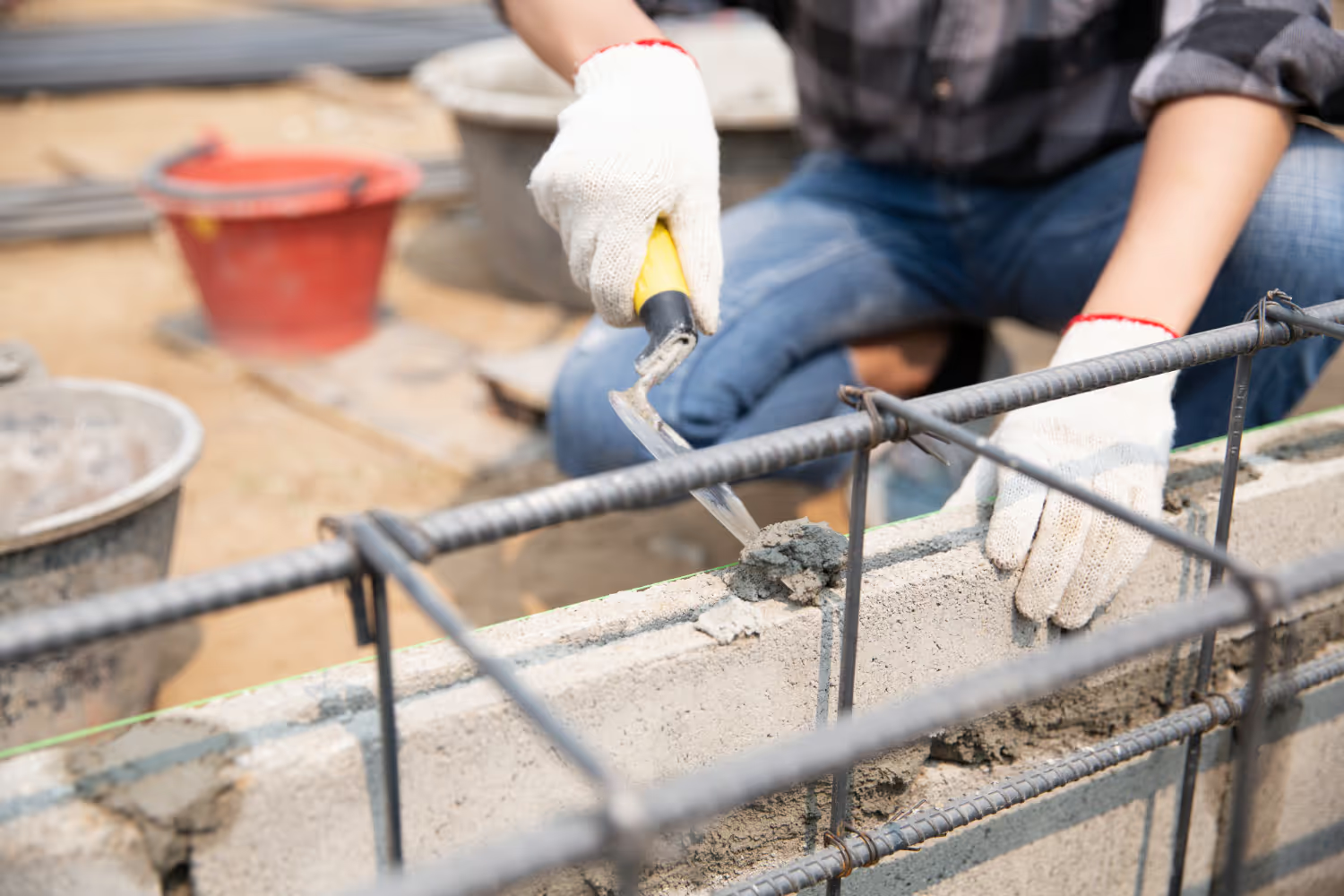
The traditional mason builds walls, floors, foundations, and other hard structures. It is one of the most emblematic jobs in construction, guaranteeing the stability and quality of structures.

The sector's figures confirm its importance:


✔ Job among the most in demand in the construction industry, representing an important part of recruitments.

✔ More than 15,000 positions open every year in France.

A technical and manual profession


Preparing mortars, installing bricks and cinder blocks, formwork and reading plans: the mason must combine precision, endurance and craftsmanship.

Training to become a traditional mason: everyone has their own path

What training courses should you follow to become a traditional mason?

The different types of training available

  1. CAP Mason/CAP Masonry
  • Duration: 2 years after the 3rd.
  • Audience: young people or adults in the process of retraining.
  • Objective: foundations, raising walls (bricks, cinder blocks), mortars/concrete, reading plans, security.
  • Where? CFA, vocational high schools.
  1. Bac Pro Building Technician - Organization and Realization of GO (TBORGO)
  • Duration: 3 years
  • Audience: post-3th or holders of a CAP.
  • Advantage: versatility + structural work + first team responsibilities and site organization.
  • Where? CFA, technical high schools.
  1. Professional Degrees/CQP (Mason, Reinforced Concrete Builder, Ancient Building)
  • Duration: 3 to 12 months depending on specialty.
  • Audience: adults in retraining, temporary workers, professionals.
  • Advantage: practical specialization (coatings, chains, traditional masonry, heritage restoration).
  • Where? AFPA, GRETA, construction organizations.
  1. Additional certificates & clearances
  • Contents: AIPR, SST, working at height, assembling/usingscaffolding, gestures & postures.
  • Advantage: reinforced safety and better employability on new construction sites and renovation.
  • Where? authorized organizations, OPCO, companies.
  1. Alternation
  • Advantage: learning in a real situation (pace, quality, safety) + remuneration.
  • Compatible courses: CAP, Bac Pro, Pro/CQP titles.
  • Where? masonry companies, structural work, restoration of ancient buildings.
  1. VAE/Continuing education
  • Audience: skilled workers who want to have their skills recognized.
  • Objective: Get a Cap/BAC Pro by the VAE, or increase your skills (old buildings, finishes, advanced reading of plans).
  • Ideal for: evolve into a team leader without starting over a long course of studies.

Comparison of training courses — Traditional mason

Formation Durée Public cible Avantages Prix
CAP Maçon / Maçonnerie 2 ans Jeunes, reconversion Bases du métier + sécurité Gratuit / CPF
Bac Pro TBORGO 3 ans Post-3ᵉ, post-CAP Polyvalence + encadrement Gratuit / CPF
Titres Pro / CQP 3–12 mois Adultes, pros Insertion rapide + spécialité CPF / OPCO / France Travail
Certificats (AIPR, SST, échafaudages) 2–5 jours Tous publics Sécurité + employabilité Entreprise / OPCO
Alternance Variable Jeunes & pros Pratique + salaire Entreprise / OPCO
VAE / Continue Flexible Salariés expérimentés Reconnaissance d’expérience CPF / OPCO

💡 Coup d’œil Asap.work

Pour entrer vite dans le métier, vise un CAP en alternance : tu prends des automatismes sur le terrain et bâtis ton réseau.

Déjà maçon expérimenté ? Combine une VAE avec un CQP Bâti ancien pour te positionner sur la rénovation patrimoniale — un segment qui paie bien et recrute.

How does a traditional mason training take place?

Skills taught in training

By following a traditional mason training, you will acquire:

🧱 Masonry techniques

  • Assemble brick, cinder block, stone or concrete block walls.
  • Build reinforced concrete foundations, floors and slabs.
  • Apply coatings, joints and ensure finishes.
  • Read and interpret construction plans.

⚒️ Safety and regulations

  • Respect the DTU standards and rules of the art.
  • Set up collective and individual protective equipment.
  • Prevent risks related to handling and construction products.
  • Use scaffolding and formwork safely.

🛠️ Professional practice

  • Practical work on school sites.
  • Internships in companies with a real situation.
  • Learning modern techniques (reinforced concrete, decorative concrete).
  • Alternating possible to learn directly in the field.

Access conditions

  • CAP Mason : accessible after 3rd.
  • Bac Pro Building Technician Structural Work : to deepen and access more responsibilities.
  • Title: Pro Mason : for adults in retraining or construction professionals.
  • VAE : validation possible after at least 1 year of experience as a mason.

The steps to integrate a training

  • Parcoursup : for CAP and Bac Pro.
  • Direct application : with CFAs, professional high schools or training organizations.
  • Adult retraining : via AFPA, GRETA, CPF and France Travail funding.
  • Alternation : possible integration into a masonry or structural construction company.

Nouveau call-to-action

Opportunities and possible developments for a traditional mason

From companion to team leader

Confirmed mason: complete structures (walls, slabs, stairs), coatings and complex repairs.

Masonry team leader: You organize the position, distribute the tasks and ensure the quality controls.

Supervision and site management

GO site manager: coordination of structural engineering bodies, deadlines and security.

Construction manager: technical/financial monitoring of several projects in parallel.

Specializations/crafts

Heritage/stone masonry : restoration, lime mortars, traditional techniques.

Decorative masonry : decorative concrete, facings, high-end plasters.

Footbridges

Multi-purpose machine operator : if you complete with CACES and earthworks.

Creation of a craft business : general masonry activity or local TCE.

Conclusion

Becoming a mason means building the foundations and walls that structure our cities. An ancestral profession, always in high demand, and which opens up multiple opportunities. Do you want to evolve? Asap.work can support you on your journey. 🧱🏠

Take action and become the builder of tomorrow.

What is the salary of a traditional mason?

The salary of a traditional mason starts at €1,850 gross/month, and can reach €2,700 gross/month for a confirmed profile with several years of experience.

Can you become a traditional mason without a BTS or higher diploma?

Yes, you can become a mason without a degree by entering as a labourer and learning in the field. But a CAP Masonry greatly facilitates hiring and development.

What are the main materials used by a traditional mason?

The mason works mainly with brick, stone, cinder block and concrete. He works on foundations, load-bearing walls, partitions and structural structures.

Does a mason always work outside?

Most of the time, yes. But it can also be used indoors during renovations or on certain specific structures.

Nos ressources

Nos dernières ressources

Calcul du salaire pour 24h par semaine : guide pour les recruteurs du BTP

Bien comprendre le calcul du salaire pour 24h/semaine est indispensable pour proposer une rémunération juste et conforme à la loi.

Contrats et réglementations

SMIC Net 2026 : Tout savoir sur ton salaire et son évolution (Guide complet)

Tu viens de recevoir ta première paie de l’année ou tu cherches ta prochaine mission d’intérim et une question te brûle les lèvres : combien gagne-t-on vraiment en 2026 ?

Entreprise

Créer une offre d'emploi irrésistible : Le guide complet pour attirer les meilleurs talents BTP en 2026

Dans un marché du travail sous tension, où la pénurie de main-d'œuvre qualifiée dicte sa loi, votre capacité à recruter ne dépend plus seulement de la notoriété de votre enseigne. Elle dépend de votre vitrine immédiate : votre annonce.